The Man Who Taught Surgeons How to Save Children's Hearts — and Never Got a Medical Degree
The Man Who Taught Surgeons How to Save Children's Hearts — and Never Got a Medical Degree
Vivien Thomas had hands that could do things most trained surgeons couldn't. He could suture vessels thinner than a strand of hair, design instruments that didn't yet exist, and solve surgical problems that stumped men with medical degrees. He did all of this as a Black man in 1940s Baltimore, working in a hospital where he wasn't allowed to eat in the cafeteria. His name didn't appear on the landmark paper. It took decades for the world to catch up.
A Plan That Collapsed Overnight
Vivien Thomas grew up in Nashville, Tennessee, the son of a carpenter. He was sharp, disciplined, and had a plan: save enough money working construction to pay his way through Tennessee Agricultural and Industrial State College, then apply to medical school. It was an ambitious road for a young Black man in the Jim Crow South, but Thomas was the kind of person who made ambitious roads feel navigable.
Then 1929 happened. The stock market crashed, the bank holding his savings failed, and Thomas's plan evaporated in the space of a few weeks. He was nineteen years old with no money, no degree, and a future that had just been repossessed.
In 1930, he took a job as a laboratory assistant at Vanderbilt University, working for a surgeon named Alfred Blalock. It was supposed to be temporary. It turned out to be the beginning of one of the most consequential — and most unjust — partnerships in the history of American medicine.
The Education That Wasn't Supposed to Happen
Blalock was a driven, ambitious researcher, and he quickly recognized that Thomas was something unusual. Within months, Thomas had moved far beyond the basic tasks of a lab assistant. He was conducting experiments independently, developing surgical techniques, and solving problems that Blalock brought to him the way you'd bring a puzzle to someone you trusted to crack it.
Thomas had no formal training. He learned by watching, by doing, by reading everything he could get his hands on, and by the kind of relentless practice that turns instinct into mastery. By the mid-1930s, he was performing experimental procedures on animals with a precision that visiting surgeons found difficult to believe. Some of them assumed he had a medical degree. He did not. He was classified by Johns Hopkins — where Blalock moved in 1941, taking Thomas with him — as a janitor. His pay reflected that classification for years.
In Baltimore, the humiliations were structural and constant. Thomas wore a white lab coat, the same as the doctors around him, but he couldn't eat with them, couldn't use the same facilities, and was paid a laborer's wage while doing a scientist's work. He almost quit more than once.
He didn't. Partly out of loyalty to the work itself. Partly, perhaps, because he understood that what they were building together was genuinely important.
Blue Babies and the Operation Nobody Believed In
In the early 1940s, a pediatric cardiologist at Johns Hopkins named Helen Taussig came to Blalock with an idea. She had been studying blue baby syndrome — a condition where infants are born with a heart defect that starves their blood of oxygen, turning their skin a frightening shade of blue and condemning most of them to early death. Taussig believed a surgical solution existed. She needed someone to build it.
Blalock turned to Thomas.
What followed was roughly two years of surgical experimentation that pushed the boundaries of what anyone thought possible. Thomas developed the procedure in the lab, working on dogs, refining the technique through hundreds of attempts until he had something that worked consistently. He designed instruments that didn't exist. He troubleshot problems in real time. The operation — a shunt connecting the subclavian artery to the pulmonary artery, rerouting blood flow around the defect — was almost entirely his construction.
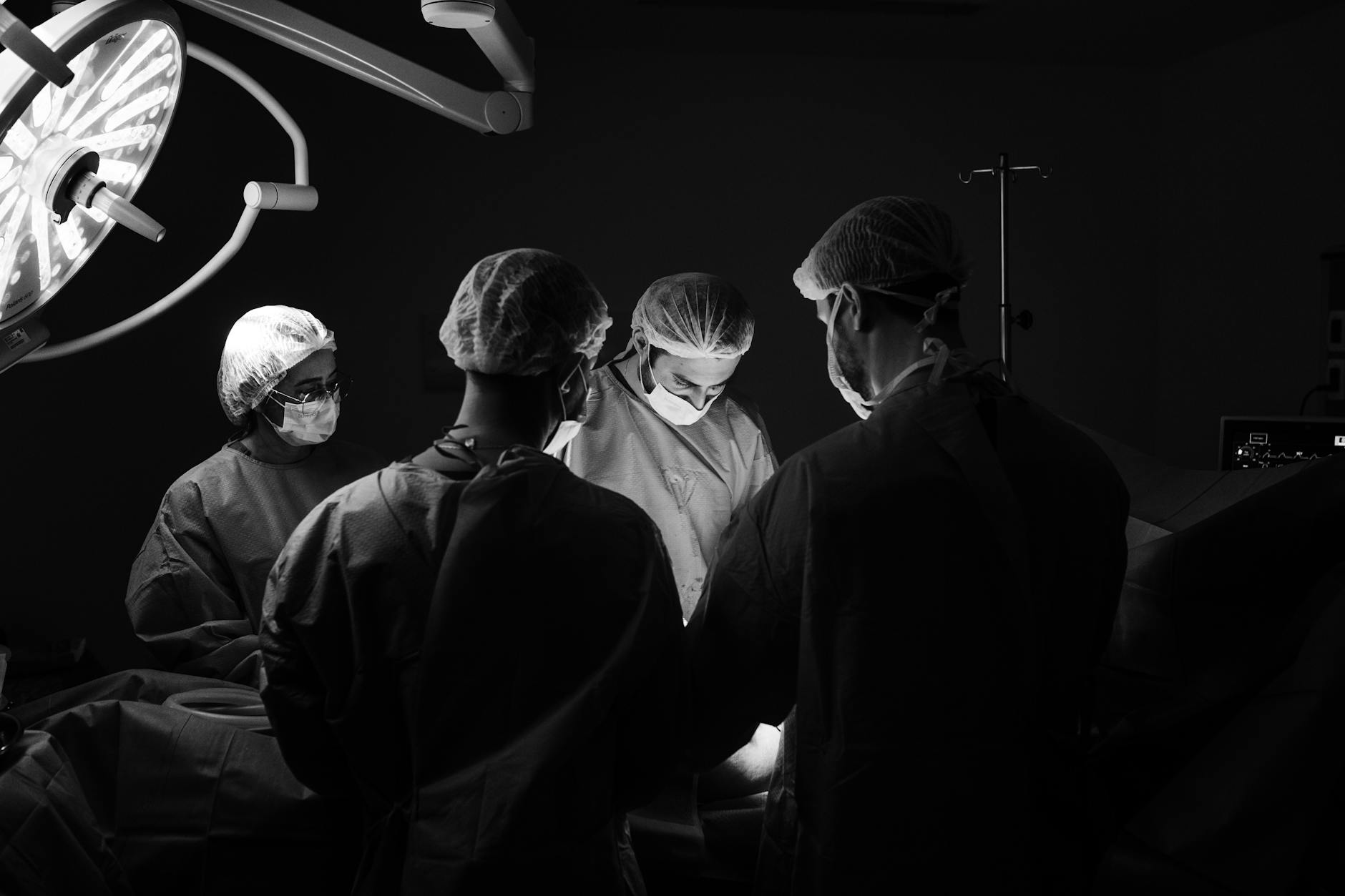
On November 29, 1944, surgeon Blalock performed the procedure on a fifteen-month-old girl named Eileen Saxon, who weighed not quite ten pounds and was not expected to survive another week. Thomas stood on a step stool behind Blalock during the operation, guiding him through each step. When the clamps were released and the color began returning to the baby's skin, everyone in the room understood they had crossed a threshold.
The paper announcing the breakthrough was published in 1945. It listed Blalock and Taussig as authors. Thomas's name did not appear.
The Long Road to Recognition
For decades, the story was told without him. The procedure became known as the Blalock-Taussig shunt. Medical students learned the history of cardiac surgery and heard nothing about the man who had essentially invented the technique in a basement laboratory.
Thomas kept working at Johns Hopkins. He trained generations of surgeons — Black and white — who went on to shape American medicine. He was, by all accounts, a more effective teacher than most of the credentialed professors around him. The surgeons he trained knew exactly what they owed him, even when the institution didn't acknowledge it.
Change came slowly. In 1968, Johns Hopkins finally appointed Thomas as a supervisor in the surgery department — a title with real authority. In 1976, the university awarded him an honorary doctorate. A portrait of Thomas was hung in the Johns Hopkins medical building — the first portrait of a Black man to hang there — placed directly across from a portrait of Blalock.
Thomas died in 1985. He had spent the preceding years writing a memoir, Partners of the Heart, which finally told the full story in his own words. A 2004 HBO film, Something the Lord Made, brought his name to a wider audience for the first time.
What We Owe the People We Erased
Vivien Thomas's story is, in one sense, a story about race and the specific cruelties of mid-century American institutional life. But it's also something broader: a story about how systems decide whose intelligence counts, whose hands are worth crediting, whose name gets attached to the work.
He didn't change the world despite those systems. He changed it while navigating them, day after day, in a white coat that the institution quietly refused to officially acknowledge.
Somewhere in the United States right now, there are children — and their children, and their children's children — who are alive because of an operation that Vivien Thomas built in a basement laboratory in Baltimore, seventy years ago.
His name is on it now. It took long enough.