The Voice in the Stone
William Edmondson was fifty-seven years old when God started talking to him through limestone. Or at least, that's how the Nashville gravedigger explained what happened in his backyard one afternoon in 1931. He'd been hauling cemetery stone for most of his adult life, his hands intimate with the weight and grain of Tennessee marble, when something shifted. The stone began speaking back.
"Jesus has planted the seed of carving in me," Edmondson would later tell anyone who asked about his sudden transformation from laborer to artist. What he didn't mention was that those same calloused hands that had spent decades preparing final resting places were about to create some of the most haunting and powerful sculptures in American art history.
A Life Built Underground
Edmondson's path to artistic recognition was anything but conventional. Born around 1874 in Davidson County, Tennessee, he grew up in the post-Reconstruction South, where opportunities for Black men were scarce and mostly involved backbreaking labor. He worked as a janitor at Nashville's Women's Hospital, tended horses at the racetrack, and eventually found steady work as a gravedigger and stonecutter.
For thirty years, Edmondson shaped headstones and prepared burial sites, his work invisible to everyone except the grieving families who needed his services. He lived quietly in a small house on Charlotte Avenue with his wife Laura, existing on the margins of Nashville society, another face in the crowd of working men who kept the city running.
But all those years handling stone had been an education. His fingers learned the language of limestone, how it yielded to pressure, where it would crack, how to coax shapes from stubborn rock. Without realizing it, Edmondson was serving an apprenticeship that no art school could have provided.
The Divine Commission
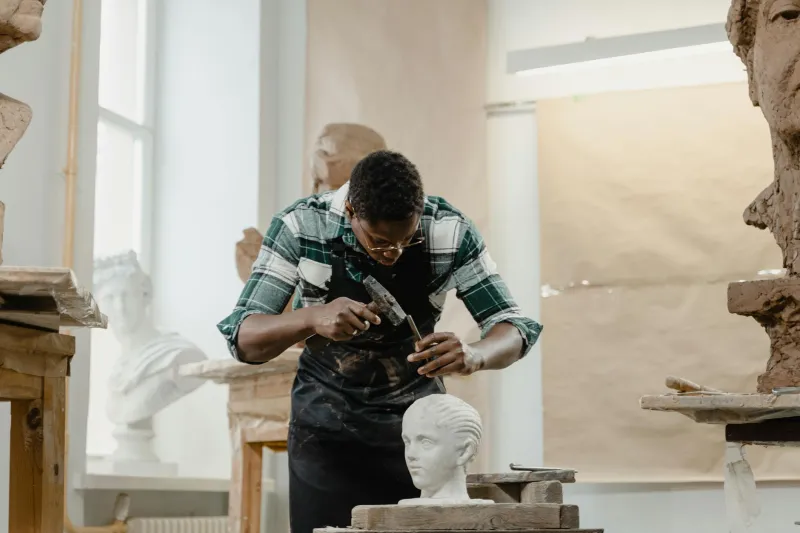
When the visions came, they came with specific instructions. Edmondson fashioned his own tools from railroad spikes and old files, creating chisels that fit perfectly in his work-hardened hands. In his backyard, surrounded by discarded tombstone fragments and limestone scraps, he began carving.
The figures that emerged were unlike anything in the American art world. Angels with knowing eyes, preachers caught mid-sermon, animals that seemed to breathe within their stone bodies. Edmondson's sculptures carried the weight of his experience—the dignity he'd witnessed in grief, the quiet strength of working-class life, the spiritual certainty that had guided him through decades of invisible labor.
His technique was entirely self-taught, developed through trial and error in a workspace that doubled as his backyard. He carved directly into the stone without preliminary sketches, letting each piece reveal itself as he worked. The results were raw, powerful, and completely original.
Discovery in Plain Sight
For several years, Edmondson's sculptures accumulated in his yard like a secret garden visible only to neighbors and passersby. Word began to spread through Nashville's small arts community about the gravedigger who was creating something extraordinary behind his modest home.
The breakthrough came when Louise Dahl-Wolfe, a photographer for Harper's Bazaar, visited Nashville and stumbled upon Edmondson's backyard gallery. Her photographs of his work caught the attention of Alfred Barr Jr., the founding director of New York's Museum of Modern Art.
Barr recognized something unprecedented in Edmondson's sculptures—a voice that was authentically American yet completely outside the established art world's influence. Here was an artist who had developed his vision in complete isolation, creating work that spoke to universal themes through deeply personal expression.
Breaking the Museum Walls
In 1937, the Museum of Modern Art mounted "Sculptures by William Edmondson," making him the first African American artist to receive a solo exhibition at the prestigious institution. The show was groundbreaking not just for its racial significance, but for its recognition of self-taught art as worthy of serious consideration.
The exhibition drew crowds and critical acclaim. Art critics struggled to categorize Edmondson's work—it wasn't folk art in any traditional sense, nor did it fit neatly into modernist movements. It was something entirely new, emerging from a life experience that the art world had never before acknowledged.
Edmondson himself remained largely unmoved by the attention. He continued living in his Charlotte Avenue home, carving when the spirit moved him, selling pieces for modest sums to support himself and Laura. Fame didn't change his routine or his relationship with his work.
The Long Shadow of Recognition
The success at MoMA opened doors that had been permanently sealed for Black artists. Edmondson's work was acquired by major museums, and his influence began appearing in the work of other self-taught sculptors. He had proven that artistic genius could emerge from anywhere, that a lifetime of manual labor could be the perfect preparation for creating transcendent art.
But perhaps more importantly, Edmondson's story challenged fundamental assumptions about who gets to be called an artist. His sculptures carried the authority of lived experience, the weight of hands that had shaped stone for practical purposes before they shaped it for beauty.
The Vision Continues
William Edmondson continued carving until his death in 1951, never losing his conviction that he was following divine guidance. His backyard remained his studio, his tools stayed homemade, and his vision remained uncompromised by success.
Today, his sculptures reside in major museums across America, testament to the idea that remarkable art can emerge from the most unlikely circumstances. Edmondson's journey from gravedigger to celebrated sculptor reminds us that genius often develops in silence, shaped by years of patient work that prepares hands and hearts for the moment when vision finally demands expression.
His story proves that sometimes the most profound artistic breakthroughs come not from formal training or connections, but from a lifetime of honest labor combined with an unshakeable belief in one's calling—even when that calling arrives at fifty-seven, speaking through limestone in a Nashville backyard.