The Man Who Learned Beauty from the Dead
He Dug the Graves. Then He Carved the Monuments.
There is a particular kind of attention that only comes from working among the dead. Not morbid fascination — something quieter than that. An eye for how a body carries its weight. How a shoulder droops under sorrow. How a hand reaches across a casket lid and says everything a person can't bring themselves to say out loud.
John Donahue learned all of this before he ever picked up a chisel.
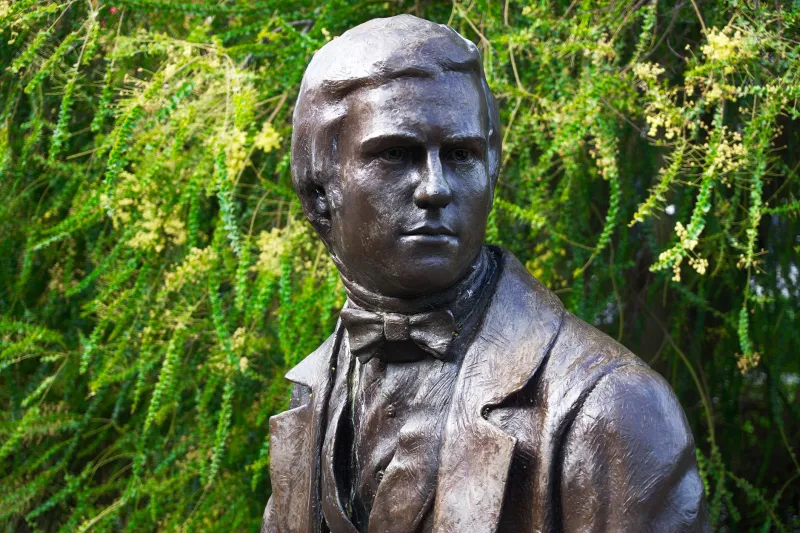
 Photo: John Donahue, via cdn.sanity.io
The Cemetery as Classroom
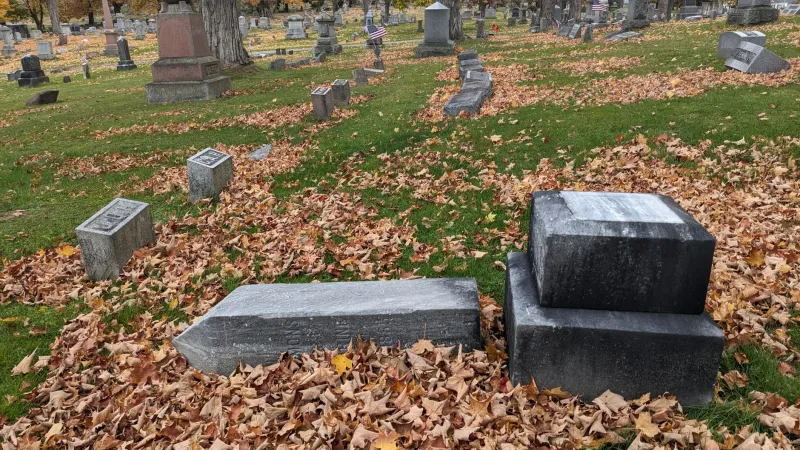
Donahue grew up in a working-class family in central Ohio during the 1840s, the third son of Irish immigrants who had settled near Columbus after the famine years. Formal education was brief and unremarkable. By seventeen, he was doing seasonal farm labor. By twenty, through a connection his uncle had with the groundskeeper of a small municipal cemetery outside Zanesville, he had a steady job with a shovel.
It wasn't glamorous work. It wasn't even particularly well-paid. But Donahue was observant in a way that surprised the people around him — not bookish, not artistic in any obvious sense, just quietly, almost disturbingly attentive. Coworkers remembered him pausing mid-dig to watch a widow at a graveside service fifty yards away. Not staring, exactly. Studying. The tilt of her head. The particular way grief made her stand differently than she probably stood at home.
He kept small notebooks. Not journals — he wrote almost nothing in them. They were filled with rough sketches. Hands, mostly. Faces in profile. The lines of a bent spine. The angle of a jaw clenched against crying. He filled four of them over six years without showing them to a single person.
The Accident That Started Everything
In 1851, the cemetery took delivery of a damaged marble headstone — cracked during transport, too flawed to install, destined to be discarded. Donahue asked if he could have it. Nobody cared enough to say no.
What he did with it over the next three months, working evenings in the shed behind his rooming house with borrowed tools and no instruction whatsoever, was rough and imperfect. But the figure he carved — a seated woman, head bowed, hands folded in her lap — had something in it that stopped people cold. It didn't look like a beginner's work. It looked like something a person had spent years preparing to make.
Because it was.
A local stonemason named Garrett Webb saw the piece, asked to meet the man who made it, and within a year had taken Donahue on as an apprentice. Webb later told people he'd never encountered anyone who understood the human form so intuitively without any formal training. Donahue, he said, already knew things about weight and posture and emotional expression that most trained sculptors spent a decade trying to learn.
The cemetery had taught him. Six years of watching people grieve had given him a graduate education in the human body under emotional stress.
From Ohio to the National Stage
Donahue's rise after that was neither fast nor easy. He spent his thirties doing commercial stonework — architectural ornaments, decorative friezes, the occasional grave marker for families who could afford something more than a plain slab. He wasn't famous. He wasn't even particularly well known outside a small circle of Ohio craftsmen and collectors.
But his reputation for public monuments grew steadily. His first major commission came in 1863, a memorial for an Ohio county that had lost nearly two hundred men in the first two years of the Civil War. The piece — a bronze soldier, not triumphant, not heroic in the chest-out, sword-raised tradition of the era, but exhausted, standing, still — caused something close to a sensation when it was unveiled. Veterans in the crowd reportedly wept. Several said it was the most accurate depiction of what the war actually felt like that they had ever seen rendered in metal.
That commission led to another, and another after that. By the 1870s, Donahue was one of the most sought-after memorial sculptors in the Midwest. By the 1880s, his work had spread to the East Coast.
What the Art Schools Couldn't Have Given Him
Later in his life, Donahue was occasionally asked whether he regretted not having formal training. Whether he felt he'd lost time, or arrived late, or missed something by spending his formative years with a shovel instead of in a studio.
His answer, by most accounts, was always some version of the same thing: that the cemetery had given him something no school could replicate. That watching real grief, real bodies, real people at the worst moments of their lives, had taught him what sculpture was actually for. Not to impress. Not to demonstrate technical mastery. To hold something true.
"Any man can learn to carve a muscle," he reportedly told a young student once. "Very few learn to carve what a muscle is doing when it's trying not to break."
The Vault Angle
Donahue's story doesn't fit neatly into the standard American success narrative — no dramatic reinvention, no single eureka moment, no rags-to-riches leap. What it offers instead is something rarer: a portrait of an education hiding inside an unlikely life. Six years of digging graves, filling notebooks, watching strangers grieve. Six years that looked, from the outside, like nothing at all.
The art world of his era never quite knew what to make of him. He hadn't gone to the right schools. He hadn't studied in Europe. He hadn't come up through the accepted channels. He was, by every conventional measure, the wrong kind of person to be making the right kind of art.
And yet there it is. His work still stands in public squares across Ohio, Pennsylvania, and Virginia. Families still gather around his figures on Memorial Day. Veterans still lay flowers at the feet of his exhausted bronze soldiers.
He learned it all in a cemetery. With a shovel, four notebooks, and six years of paying attention to the things most people looked away from.
Turns out that's enough.